
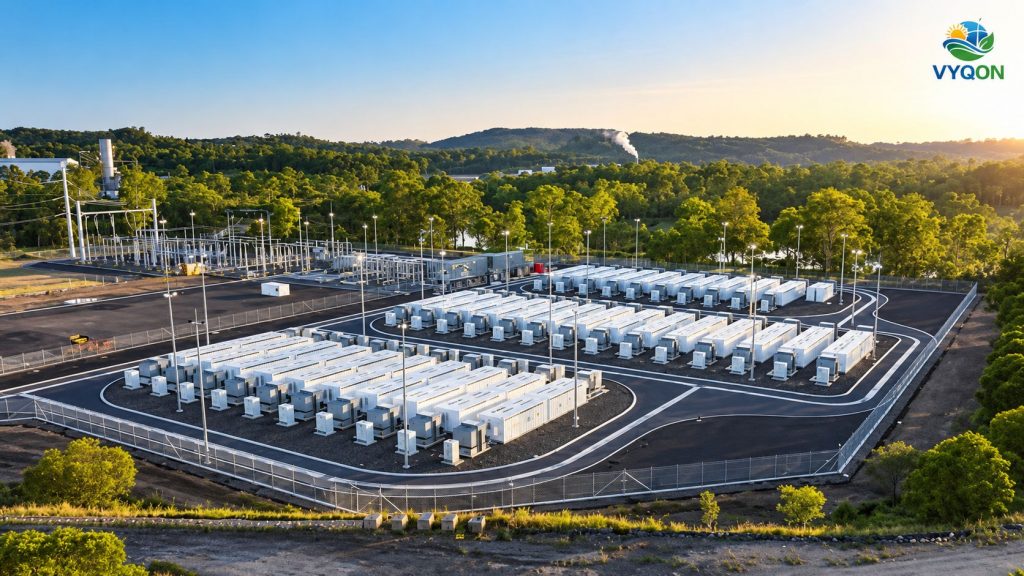
NTPC Vidyut Vyapar Nigam Limited (NVVN), the wholly owned power trading subsidiary of NTPC Limited, is set to synchronise its first Battery Energy Storage System (BESS) with the grid within days. Chief Executive Officer Somes Bandyopadhyay said on 8 October 2026 that the 500 MWh project will be synchronised “in a few days’ time”, with commercial operation to follow. He was speaking to reporters on the sidelines of the 18th India Coal Summit, organised by the Indian Chamber of Commerce in New Delhi.
The project marks NVVN’s entry into battery energy storage, a notable step for a company whose core business has so far been electricity trading. The location and developer of the project were not disclosed in the CEO’s remarks.
NVVN and NTPC had not issued an official press release on the project at the time of writing. The project details below are from the CEO’s remarks, as reported by the Press Trust of India (PTI).
What the CEO Announced
Bandyopadhyay outlined NVVN’s near-term storage plans in three parts:
- First project: 500 MWh of BESS capacity to be synchronised within days, with commercial operation shortly after.
- Next phase: A further 500 MWh targeted for commissioning within the current financial year (FY 2026-27), taking NVVN’s operational storage to around 1,000 MWh.
- Longer pipeline: The Government of India has given NVVN a scheme covering 3,000 MWh of battery storage, under which the company is participating in battery storage through different modes.
Why Grid Synchronisation Matters
Synchronisation is the stage at which a BESS is first connected to the grid and operates in step with its frequency and voltage. The plant then goes through trial operation and testing before its Commercial Operation Date (COD) is declared, from which the capacity is available for dispatch.
COD also matters financially. Under the Ministry of Power’s 2023 VGF scheme, 10% of a project’s VGF is released at financial closure, 45% on achieving COD, and 15% a year over the following three years.
How NVVN Procures Battery Storage
Under NVVN’s model, private developers win capacity through tariff-based competitive bidding, then build, own and operate standalone BESS. Each winner signs a Battery Energy Storage Purchase Agreement (BESPA) with NVVN for the contracted capacity.
IndiGrid’s own disclosures show how these contracts work. Its 250 MW/500 MWh standalone BESS in Rajasthan was awarded by NVVN in November 2024 on a build-own-operate basis, with a 12-year contract running from COD. The agreement was signed in December 2024, and IndiGrid lists the project as under construction. In February 2026, IndiGrid also announced an agreement to acquire a 125 MW/500 MWh standalone BESS in Uttar Pradesh contracted by NVVN, for an enterprise value of up to about ₹957 crore.
Policy Support Behind the Project
The Centre’s main financial instrument for grid-scale storage is Viability Gap Funding (VGF). The Union Cabinet approved the first VGF scheme on 6 September 2023 with an initial outlay of ₹9,400 crore, including ₹3,760 crore of budgetary support. It offered up to 40% of capital cost for 4,000 MWh of BESS by 2030-31, targeted a Levelised Cost of Storage of ₹5.50-6.60 per kWh, and required at least 85% of project capacity to be made available to discoms.
As battery prices fell, the Ministry of Power told the Lok Sabha in April 2025 that the scheme’s capacity had been raised from 4,000 MWh to 13,200 MWh within the same ₹3,760 crore budget. The VGF amount fell from an estimated ₹96 lakh per MWh to ₹46 lakh per MWh or 30% of capital cost, whichever is lower.
In June 2025, the Ministry of Power approved a second VGF scheme for 30 GWh of BESS, backed by ₹5,400 crore from the Power System Development Fund (PSDF). The scheme order is dated 9 June 2025.
The Bigger Picture
The National Electricity Plan 2023 estimates that India will need 236 GWh of BESS by 2031-32, the Ministry of Power has told Parliament. NVVN’s first project reaching grid synchronisation is an early example of a central-sector storage programme moving from auction to operation. Its performance will be watched by discoms and developers bidding into similar BESPA-based tenders.
For NTPC Group, the project also adds a new operational lever alongside its large thermal and renewable portfolio, supporting peak demand management and the integration of growing solar and wind capacity into the grid.
References
Official sources
- PIB: Cabinet approves the Scheme for Viability Gap Funding for development of BESS (6 Sep 2023)
- Lok Sabha Unstarred Question No. 5329: Viability Gap Funding for BESS, answered 3 Apr 2025
- Ministry of Power order: VGF Scheme for BESS supported through PSDF, 9 Jun 2025 (official copy on MNRE website)
- Ministry of Power, official X account, on the June 2025 VGF scheme
- IndiGrid: Rajasthan BESS Private Limited (250 MW/500 MWh, NVVN-awarded)
- IndiGrid Q3 FY26 earnings release (NVVN-contracted 125 MW/500 MWh project in Uttar Pradesh)
News reports of the CEO’s remarks (no official release available yet)
Leave a Comment