
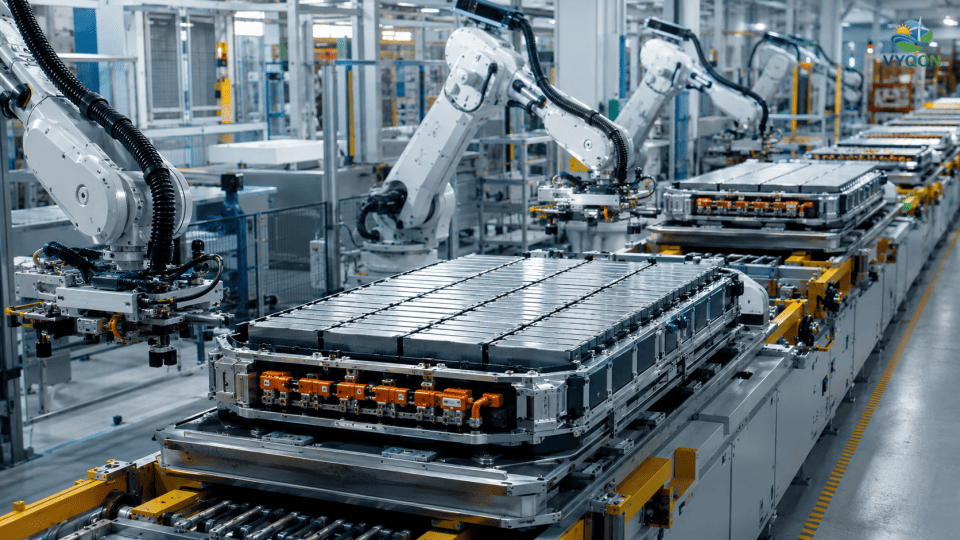
Octillion Power Systems, the Silicon Valley-based Tier-1 supplier of electric vehicle (EV) battery systems, has commissioned its third Indian manufacturing facility in Halol, Gujarat. The new site adds 3 GWh of annual energy storage capacity, enabling the production of over 48,000 battery systems yearly and bringing Octillion’s cumulative Indian capacity to more than 9 GWh. Demonstrating significant operational agility, the plant was transitioned from an empty structure to a fully operational site in under eight months by retrofitting an existing 13,000-square-meter industrial facility.
Retrofit Strategy: Bypassing Traditional 24-Month Scaling Timelines
The rapid commissioning of the Halol site underscores Octillion’s strategy to scale alongside India’s volatile demand curves. While industrial battery assembly lines typically necessitate 18 to 24 months for greenfield preparation and precision tooling, Octillion bypassed these timelines by utilizing a retrofit model. This approach allowed the company to implement safety compliance testing and cleanroom environments within a fraction of the standard industry duration.
Halol Facility Operational Metrics:
- Annual Energy Storage Capacity: 3 GWh
- Annual Unit Output: 48,000+ battery systems
- Facility Footprint: 13,000+ square meters
Scaling the Footprint: Surpassing the 100,000-Unit Milestone
The addition of the Gujarat hub solidifies Octillion’s national presence, which now comprises three distinct manufacturing centers: the new Halol plant and two established facilities in Pune, Maharashtra.
This expansion follows a major operational landmark for the company; Octillion’s India division recently surpassed the 100,000 EV battery system milestone across its local facilities. This volume of real-world deployment validates Octillion’s Tier-1 status as it moves toward a new projected output.
The combined national totals now stand at 9 GWh of annual capacity and a production capability exceeding 150,000 battery systems.
This infrastructure supports a diverse array of vehicle segments, including:
- Passenger cars and new crossover models
- Light commercial vehicles (LCVs)
- Heavy-duty trucks
- Public transport buses
Strategic Proximity: Integrating into the Western India Auto Cluster
Positioning the 3 GWh plant in Halol is a strategic move to integrate directly into the Western India automotive manufacturing cluster. By situating production adjacent to major Original Equipment Manufacturer (OEM) assembly plants, Octillion secures several logistical advantages:
- Reduced Freight Costs: Minimized transportation overhead for bulky battery packs.
- Elimination of Transit Delays: Real-time supply chain responsiveness to OEM assembly schedules.
- Direct Technical Integration: Seamless deployment of customized Battery Management Systems (BMS) directly on-site at OEM campuses.
Tropical Engineering: Optimizing LFP Chemistry for 45°C+ Peaks
Engineering battery systems for the Indian subcontinent requires solving for extreme ambient temperatures that frequently exceed 45°C. While Lithium Iron Phosphate (LFP) has emerged as the preferred chemistry for the region due to its inherent thermal stability and falling cell costs, it still requires sophisticated management to prevent degradation in tropical climates.
Octillion’s technical edge lies in its localized engineering approach, which includes:
- Localized Thermal Modeling: Engineering pack architectures specifically for high-heat environments to preserve vehicle power.
- Simulated Heat/Humidity Cycles: Standardized manufacturing that utilizes extreme environmental testing to ensure packs resist thermal runaway.
- Cooling Efficiency Optimization: High-voltage system designs that maximize heat rejection without placing an excessive parasitic load on the vehicle’s energy reserves.
The H1 2026 Inflection Point: Penetration Hits 11% Amid LFP Price Floor
Octillion’s expansion arrives as the Indian market enters a high-growth phase. In H1 2026, EV registrations reached 1.54 million units, a 43% year-over-year surge. Overall EV penetration has crossed the 11% threshold, driven by the price floor of LFP cells and a wave of new crossover launches that attracted record volumes of private buyers.
H1 2026 Segment Growth Analysis:
- Passenger Vehicles: 83% growth, fueled by the rising popularity of electric crossovers.
- Public Transport: E-bus sales rose 42%, supported by a record-breaking June 2026 allocation of over 4,200 units.
- Commercial Logistics: Heavy commercial truck sales surged by over 300% as fleets pivoted to cut fuel expenses.
This momentum is further bolstered by federal incentive structures, including the PM E-DRIVE scheme and the PM E-Bus Sewa program.
Executive Perspectives: Discipline and Supply Chain Resilience
Paul Beach, Global President of Octillion Power Systems:
“India is one of the most important growth markets in the global transition to electric mobility, and this facility reflects our long-term commitment to building capacity where our customers need it most. Delivering a fully operational plant in under eight months is a testament to the discipline of our team and our ability to execute at speed without compromising the quality standards our customers depend on.”
Nikhil Parchure, SVP at Octillion Power Systems:
“A resilient EV supply chain in India can’t just mean more square footage, it means depth: local sourcing, local quality control, and local engineering talent working side by side with our global standards. That’s what we’ve built in Halol. As India moves toward its 2030 electrification targets across cars, trucks, and buses, our customers need a partner who can scale with them without exposing them to global supply chain volatility.”
Policy Synergy and the 2030 Electrification Roadmap
The Halol expansion aligns with the National Critical Minerals Mission, which has bolstered the domestic supply chain by eliminating customs duties on 25 essential minerals—most notably lithium, nickel, and cobalt. These exemptions are critical for localized pack builders looking to de-risk against global price volatility.
Octillion’s scaling is a necessary component for meeting the government’s 2030 electrification targets:
India’s 2030 Electrification Targets
| Vehicle Category | Electrification Target (%) |
| Private Passenger Cars | 30% |
| Commercial Trucks/LCVs | 70% |
| Public City Bus Fleets | 40% |
| Two and Three-Wheelers | 80% |
To realize these goals, India will require a total annual battery capacity of 150 GWh to 200 GWh by 2030. Octillion’s 9 GWh national footprint represents a vital industrial foundation in the race toward these electrification milestones.
Official Sources & Citations
- Octillion Power Systems Official Press Release: Gujarat Plant Opening Official corporate announcement regarding the commissioning of the 3 GWh manufacturing facility in Halol, Gujarat.
- Octillion Power Systems India Division Surpasses 100,000 EV Battery System Milestone Official media release documenting Octillion reaching its 100,000th battery system milestone across its Indian manufacturing facilities.
- Tata Motors to Source EV Batteries from Octillion Power Systems Official corporate update on Tata Motors partnering with Octillion to source advanced EV battery packs.
- State-of-the-Art Battery Technology with Unmatched Quality and Value Official technology overview detailing Octillion’s proprietary BMS, Bipolar Liquid Cooled Structure (BEST), and MUST technology.
Leave a Comment