
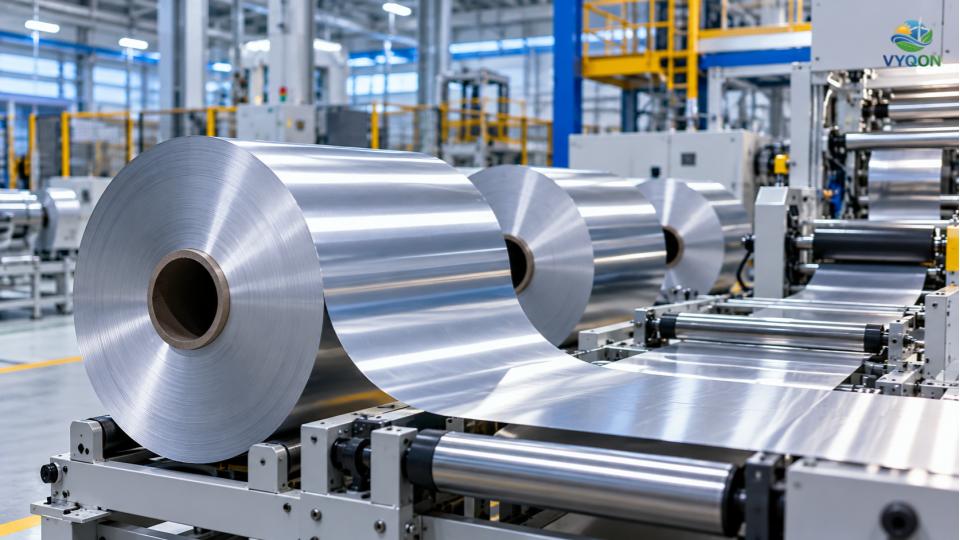
SRF Limited has approved a ₹600 crore investment to establish a battery-grade aluminium foil manufacturing facility at Jetapur, Madhya Pradesh, through its wholly owned subsidiary SRF Altech Limited. The proposed 12,000-tonne-per-year facility will serve lithium-ion and sodium-ion battery applications, with phased completion targeted for 2028 and 2030.
Gurugram, 22 October 2026: SRF Limited has announced a major investment in India’s battery materials sector, with its Board of Directors approving capital expenditure of approximately ₹600 crore to establish a battery-grade aluminium foil manufacturing facility in Madhya Pradesh.
The decision was announced on 21 October 2026, alongside the company’s financial results for the second quarter and first half of FY2026–27.
The proposed facility will be developed at the existing Jetapur site of SRF Altech Limited, a wholly owned subsidiary of SRF, and is intended to serve manufacturers operating across the energy storage and electric mobility sectors.
According to SRF’s official announcement, the project will have a planned total manufacturing capacity of approximately 12,000 metric tonnes per annum (MTPA) and will produce specialised aluminium foil suitable for lithium-ion and sodium-ion battery applications.
The development represents SRF’s planned expansion into higher-value battery materials, an industrial segment linked to the increasing adoption of rechargeable batteries for electric vehicles and stationary electricity storage.
However, the announcement constitutes a board-approved investment proposal rather than the commissioning of an operational facility. Construction progress, manufacturing readiness, commercial production and customer qualification will depend on subsequent implementation milestones.
₹600 Crore Investment to Be Implemented in Two Phases
SRF has structured the proposed manufacturing facility into two investment phases, each with an estimated expenditure of ₹300 crore.
According to the company’s announcement, the first phase is expected to be completed by September 2028, followed by the second phase by September 2030.
These dates represent planned project completion milestones and should not be interpreted as confirmed commercial production dates.
The proposed investment will be undertaken through SRF Altech at its existing industrial site in Jetapur, Madhya Pradesh.
The company’s stock-exchange disclosure indicates that the financing arrangement will involve a combination of debt and internal accruals.
However, SRF has not specified the exact contribution of each financing source or the detailed schedule for deploying the approved investment.
The company also has not disclosed separate manufacturing-capacity allocations for the two phases in its official results announcement.
Consequently, the approximately 12,000 MTPA capacity should be presented as the project’s overall announced capacity rather than assigning an unverified production volume to each phase.
The phased development strategy will allow SRF to progress through equipment procurement, facility implementation, testing and other technical requirements before reaching its intended manufacturing scale.
Why Battery-Grade Aluminium Foil Is Important
Battery-grade aluminium foil is a specialised industrial material used in rechargeable battery manufacturing.
In conventional lithium-ion battery cells, aluminium foil commonly serves as the current collector for the positive electrode.
The current collector provides an electrically conductive support for the active electrode coating and helps transfer electrical current between the electrode materials and the cell’s external circuit.
Although it represents only one component of a battery cell, its material properties can influence manufacturing quality, reliability and electrical performance.
Battery manufacturing requires precise control over foil thickness, surface consistency, mechanical strength and compatibility with electrode-coating processes.
Variations in material quality can affect coating uniformity and contribute to defects during subsequent cell production.
For this reason, battery-grade foil requires manufacturing and quality-control processes suited to the technical expectations of cell producers.
Sodium-ion batteries present another potential application for aluminium current collectors, although requirements depend on the cell chemistry and electrode configuration.
SRF has specifically identified both lithium-ion and sodium-ion batteries as intended application markets for the proposed facility.
The company has not disclosed individual foil grades, thickness specifications or customer qualification results associated with the project.
These details will become important when the proposed manufacturing facility approaches commercial production.
Supporting India’s Battery Energy Storage Supply Chain
India’s expanding renewable energy sector is increasing the importance of battery technologies capable of supporting electricity storage and flexible power supply.
Solar photovoltaic projects generate electricity according to available sunlight, while wind generation depends on changing atmospheric conditions.
Battery Energy Storage Systems (BESS) can help manage these variations by storing electricity and delivering it at a later time, subject to their power ratings, energy capacities and operating requirements.
A complete BESS installation includes battery cells, modules, racks, a Battery Management System, Power Conversion System, thermal-management equipment, protection systems and control infrastructure.
Battery-grade aluminium foil is an upstream material used within the cell-manufacturing process.
This distinction is important because the proposed SRF facility will not itself manufacture complete battery cells, battery packs or grid-scale storage installations.
Its output is intended to support the production of batteries used in such applications.
The development could contribute to India’s domestic battery materials ecosystem by adding a prospective source of specialised current-collector foil.
However, the commercial impact will depend on the facility’s ability to produce material meeting customer specifications at competitive cost and consistent quality.
The approved annual capacity is measured in tonnes of material and cannot be directly described as an equivalent number of gigawatt-hours of battery storage.
Such a conversion would require detailed assumptions regarding cell chemistry, electrode design, foil thickness and manufacturing yield.
Opportunities Across Lithium-Ion and Sodium-Ion Markets
SRF’s investment proposal identifies two rechargeable battery technology segments: lithium-ion and sodium-ion.
Lithium-ion batteries are widely used in electric mobility, consumer electronics and stationary energy storage.
Different lithium-ion chemistries serve different applications depending on required energy density, durability, thermal behaviour, cost and operating characteristics.
Lithium iron phosphate batteries, for example, are frequently considered for stationary storage applications because of their cycle-life characteristics and suitability for repeated charging and discharging when appropriately engineered.
Sodium-ion technology represents another emerging rechargeable battery category.
Its development may create additional demand for specialised electrode materials and current collectors, depending on commercial adoption and specific cell designs.
Both technology categories require reliable materials and controlled manufacturing processes.
By targeting aluminium foil for these applications, SRF is positioning the proposed facility within an industrial materials segment that serves multiple battery end markets.
However, the company has not announced confirmed supply agreements, customer names or production allocations for either battery technology.
The future commercial contribution of the facility will depend on customer acceptance, product qualification and actual demand from battery manufacturers.
SRF’s Experience in Performance Films and Foil
SRF already operates a diversified industrial manufacturing business covering chemicals, technical textiles, performance films and foil-related products.
The company’s Performance Films and Foil Business provides an established industrial platform for its proposed battery-material expansion.
Specialised foil manufacturing draws on capabilities in materials processing, precision manufacturing, surface quality and production consistency.
Although existing industrial experience may support the development of new products, battery-grade applications can impose technical requirements that differ from conventional packaging or industrial foil products.
Additional process development, specialised equipment and customer qualification may therefore be necessary before the proposed facility can supply battery manufacturers commercially.
The investment announcement was issued alongside SRF’s quarterly financial results.
For Q2 FY27, the company reported consolidated revenue of approximately ₹4,904 crore, an increase of 35% year-on-year.
Profit after tax increased by 31% to approximately ₹509 crore.
SRF’s Performance Films and Foil Business also recorded strong growth, with segment revenue increasing by 51% during the quarter.
These figures provide a broader financial context for the company’s investment strategy.
They do not represent revenue or profit generated by the proposed battery-grade aluminium foil facility, which remains under development.
Manufacturing Development and Commercial Milestones
The proposed project will need to progress through several technical and commercial stages before it contributes to India’s battery supply chain.
These stages may include detailed engineering, equipment procurement, construction, installation, process testing and manufacturing qualification.
Battery-material suppliers must establish processes that consistently meet the requirements of their customers.
This can involve technical evaluation of material dimensions, surface characteristics, mechanical properties and compatibility with electrode-manufacturing systems.
Commercial acceptance may also depend on reliability, production scale, quality assurance and supply continuity.
For industry stakeholders, the key milestones to monitor will include progress towards the September 2028 first-phase target, development of the second phase, commissioning announcements and subsequent evidence of qualified commercial production.
Customer contracts, if announced, would provide additional information about the facility’s eventual commercial position.
However, no confirmed battery-foil sales volume, customer order book or project-specific revenue target has been disclosed in the present announcement.
The company’s approved investment should therefore be evaluated as a manufacturing development proposal whose operating and financial outcomes remain subject to implementation.
Official Sources and References
1. SRF Limited — Official Press Release, 21 October 2026
SRF Limited Reports Strong Growth in Q2 & H1 FY27.
Confirms the ₹600 crore investment, approximately 12,000 MTPA total capacity, lithium-ion and sodium-ion applications, project phases and target completion dates.
https://www.srf.com/news/srf-limited-reports-strong-growth-in-q2-h1-fy27
2. SRF Limited — Official Stock Exchange Filings
Capital expenditure proposal approved by the Board on 21 October 2026.
Confirms the project through SRF Altech Limited at Jetapur, Madhya Pradesh, and the proposed financing structure.
https://www.srf.com/investor-relations/share-information/stock-exchange-fillings
3. National Stock Exchange of India — Official Corporate Announcements
Search under NSE symbol SRF, dated 21 October 2026, for the capacity-addition disclosure.
https://www.nseindia.com/companies-listing/corporate-filings-announcements?symbol=SRF
Leave a Comment