
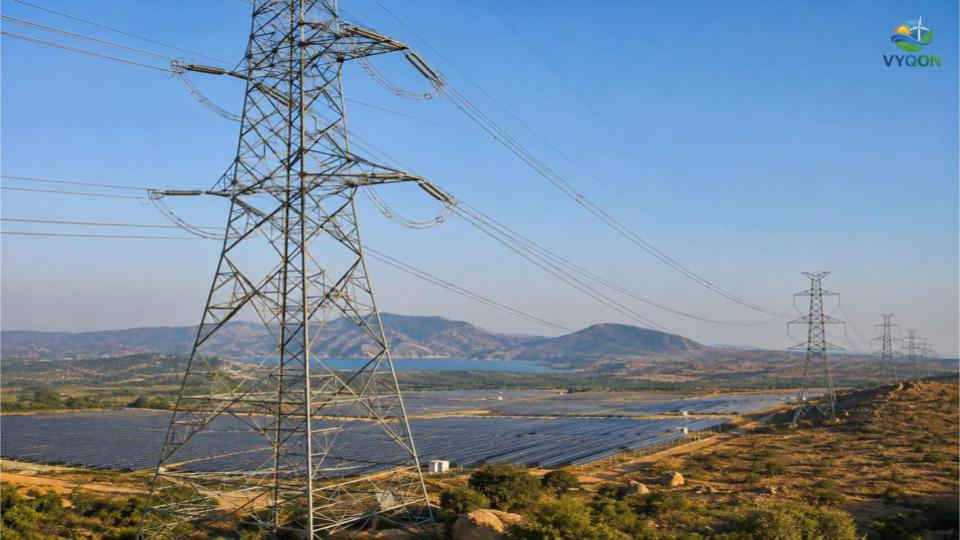
A new transmission backbone for renewable and storage power
Adani Energy Solutions Limited has won a transmission project with an estimated capital expenditure of approximately Rs 4,700 crore. The project is intended to transfer renewable electricity generated in Karnataka toward major consumption centres in Maharashtra and support the development of pumped-storage capacity in the Satara, Pune and Mumbai Metropolitan Region. The company says the scheme will facilitate the evacuation of renewable and storage power associated with a potential of up to 4,500 MW.
The project, formally identified as the Network Expansion Scheme in Western Region to Cater to Pumped Storage Potential near Satara up to 4,500 MW – Part A, was awarded through tariff-based competitive bidding. Adani Energy Solutions emerged as the lowest bidder. The asset will be developed through the special-purpose vehicle Satara Power Transmission Limited and is scheduled for delivery within 36 months.
What will be built
The scheme includes a new 765/400 kV substation at Satara, a 765 kV double-circuit transmission line between Kolhapur and Satara, augmentation of the Kolhapur pooling station and associated infrastructure. Adani Energy Solutions states that the project will add 562 circuit kilometres of transmission lines and 9,000 MVA of transformation capacity to its portfolio.
These are large grid assets rather than local distribution upgrades. High-voltage transmission allows substantial quantities of electricity to move across long distances with lower losses and provides the inter-regional connections required to link renewable-rich areas with industrial and urban demand. Transformation capacity is equally important because electricity must be converted between voltage levels before it can move through different parts of the network.
Why transmission is central to solar expansion
Solar growth is often discussed in terms of gigawatts of new panels, but generation capacity is useful only when the grid can accept and transport the electricity. Renewable projects can face curtailment or delayed commissioning if pooling stations, substations and transmission lines are not available when plants are ready. A strong corridor between southern and western regions can improve the ability to move power away from generation zones and toward demand centres.
The project is not dedicated exclusively to solar. It is designed for broader renewable and storage integration. Nevertheless, it directly supports the conditions needed for additional solar capacity: adequate evacuation, geographic balancing and access to flexible storage resources. Solar generation from one region can be complemented by wind, storage or demand in another, reducing the operational pressure that arises when all resources are treated locally.
The connection with pumped storage
Pumped-storage plants move water to an upper reservoir when electricity is available and release it through turbines when power is needed. This allows energy to be shifted across time, although the technology has different construction, geographic and environmental requirements from battery storage. For a system with growing solar generation, pumped storage can absorb electricity during periods of high renewable output and return it during evening peaks or other high-demand periods.
Transmission is necessary for this flexibility to serve a wide area. A storage plant can balance the grid only if it is connected through infrastructure capable of carrying charging and discharging power. The Satara scheme therefore links two parts of the transition that are sometimes planned separately: renewable generation and large-scale system flexibility.
Commercial and execution considerations
Winning a tariff-based project is the beginning of a multi-year execution process. The developer must secure statutory approvals, complete engineering, procure high-voltage equipment, obtain rights of way, construct substations and lines, test the system and meet contractual milestones. Land access and right-of-way coordination can be particularly challenging for long transmission routes. Supply availability for transformers, reactors, switchgear and towers will also influence the schedule.
For the solar sector, timely delivery matters because generation projects may be developed on separate schedules. If renewable capacity is completed before the network is ready, developers can face stranded output or commercial delays. Coordinated planning between generation, storage and transmission is therefore a major measure of project success.
Regional coordination will determine the real benefit
The corridor crosses the boundaries of generation, storage and consumption regions, so technical coordination among central and state institutions will be essential. Protection systems, scheduling arrangements, substation readiness and planned outages must work across the wider network. A new high-voltage line can carry large power flows, but it must also operate safely under different generation and demand conditions.
The project can create value beyond a single asset if it reduces congestion and gives system operators more options for routing renewable power. Measuring that value will require attention to utilisation, availability, curtailment and the commissioning of the projects the corridor is meant to serve. The strongest result would be a transmission asset that is ready before it becomes a bottleneck.
Conclusion
Adani Energy Solutions’ Rs 4,700 crore win illustrates the scale of grid investment required behind India’s renewable targets. The project will add substantial high-voltage infrastructure, strengthen the connection between Karnataka and Maharashtra and support the emerging pumped-storage ecosystem near key demand centres. Its value to solar development will ultimately depend on execution: completing the assets within 36 months, aligning them with generation and storage projects, and providing reliable capacity once the corridor enters operation.
Original documents and references
Source 1: Official Adani Energy Solutions release
Source details: The company release provides the award value, project scope, 36-month delivery schedule, Satara substation and transmission-line details, and the planned support for 4,500 MW of pumped-storage potential.
Direct page link: https://www.adanienergysolutions.com/newsroom/media-releases/aesl-wins-rs-4700-crore-transmission-project-in-maharashtra-for-evacuation-of-4500-mw
Source 2: Reuters supporting report
Source details: Reuters independently confirms the approximate project value and explains the transmission scheme’s role in moving renewable electricity toward Maharashtra demand centres.
Direct page link: https://www.reuters.com/business/energy/indias-adani-energy-solutions-wins-493-mln-transmission-project-maharashtra-2026-08-26/
Leave a Comment