
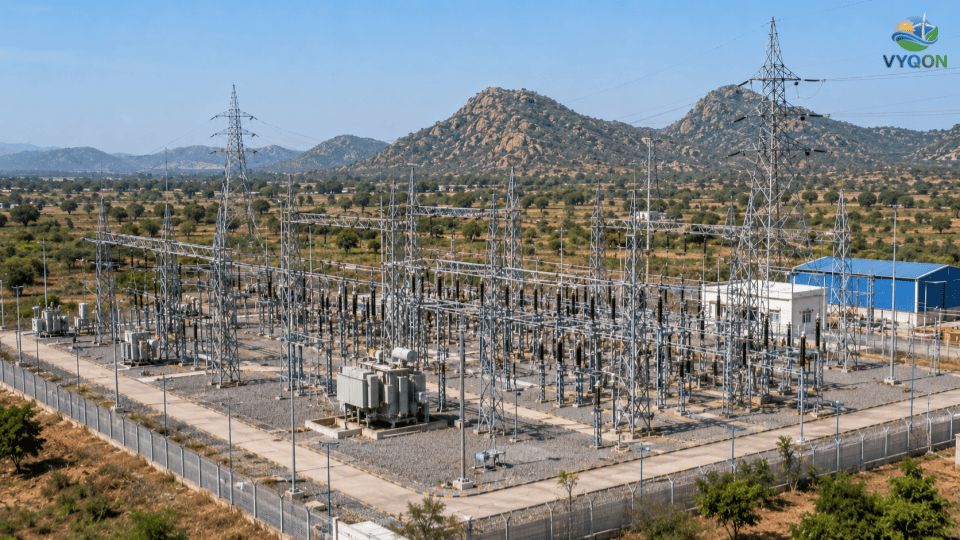
The Ahmedabad Municipal Corporation (AMC) has issued a significant tender for the development of a 75 MW (AC) grid-connected, ground-mounted solar PV project integrated with a 7.5 MW / 30 MWh Battery Energy Storage System (BESS). The project, situated in Gujarat, is structured under a Group Captive Mode, signaling a major infrastructure push for the municipal body to secure long-term, sustainable power.
Project Overview and Capacity Specifications
The project framework is designed to leverage the provisions of the Electricity Act 2003 and Electricity Rules 2005. The specific technical capacity includes a 75 MW (AC) solar array coupled with a substantial 30 MWh BESS component. AMC acts as the primary owner and captive power user, aiming to utilize the generated energy across its various municipal premises. This “Group Captive” arrangement is a strategic move to optimize power costs while meeting renewable energy obligations through self-consumption.
Special Purpose Vehicle (SPV) and Financial Structure
The project will be executed through a newly incorporated Special Purpose Vehicle (SPV), which acts as the “Employer” under the contract. The financial structure is meticulously aligned with Indian captive power regulations:
- Equity and Captive Status: In strict compliance with legal requirements for captive status, AMC will hold a 26% equity stake in the SPV. The Successful Bidder (Contractor) will hold the remaining 74% stake. This 26% threshold is critical for AMC to legally qualify as a captive consumer.
- Funding and EPC Cost: The project is structured with a 70:30 debt-to-equity ratio. The Contractor is responsible for arranging debt financing up to 70%. The 30% equity component is contributed by both partners relative to their shareholding.
- Off-taker Dynamics: While the SPV is the legal “Employer” for the execution of the contract, AMC transitions into the role of the “Off-taker” upon project completion. Energy procurement will be governed by a separate Power Purchase/Supply and Offtake Agreement (PSOA/PPA) executed between the SPV and AMC.
Scope of Work and Contractor Responsibilities
The tender defines the scope of work as a “turnkey” responsibility, meaning the EPC Project Cost is a total lump-sum figure covering all aspects of development. This places the primary execution risk on the contractor. Key responsibilities include:
- Comprehensive EPC: Total responsibility for design, engineering, procurement, supply, construction, installation, testing, and commissioning.
- Grid and Evacuation: All grid connectivity works and power evacuation infrastructure up to the nearest GETCO Renewable Energy (RE) Integration Substation (132 or 220 kV).
- Regulatory and Management: Procurement of all statutory approvals, project insurance, and full-scale project management.
- Execution Resources: Provision of all necessary services, materials, equipment, and labor required to achieve the Commercial Operation Date (COD) and maintain the plant thereafter.
Technical Standards and Performance Warranties
To ensure the long-term viability of the hybrid system, the tender mandates rigorous warranty periods and degradation limits. A key technical constraint is that any remedial capacity additions required to meet performance guarantees over the project life must be achieved within the original land footprint; no additional land will be provided for such corrections.
| Component | Minimum Warranty Period |
| Solar PV Modules (Product) | 10 Years |
| Solar PV Modules (Performance) | 25 Years (Min. 90% at 10 years; 80% at 25 years) |
| Inverters | 10 Years (as per OEM) |
| Transformers & Switchgear | 10 Years |
| Battery Energy Storage System (BESS) | 12 Years (as per OEM) |
| Overall PV Plant (Defect Liability Period) | 120 Months (10 Years) |
Degradation Limits: Performance declines are capped at 2.5% for the first year and 0.6% per annum for the remainder of the performance warranty period.
Regulatory and Financial Compliance
The contractor must navigate a complex regulatory landscape regarding taxation and metering:
- Taxation and GST: The contractor is responsible for all income, corporation, and revenue taxes. GST compliance is paramount; valid tax invoices must include correct SAC/HSN codes and the SPV’s GSTIN.
- Adjustment Timelines: The contract specifies strict financial audit timelines for GST Adjustment Notes (Credit/Debit notes). These must be issued within 15 days of a discrepancy being identified and no later than six months from the end of the relevant financial year.
- Metering and Delivery: Expert reporting distinguishes between the Metering Point (at the 33 kV level), where the Guaranteed CUF and Net Electrical Energy Generation (NEEGG) are measured, and the Delivery Point, located at the designated GETCO 132/220 kV substation for accounting and scheduling.
- Labor Compliance: Mandatory payment of ‘CESS’ under the Building & Other Workers Welfare Cess Act, 1996 is required.
Key Tender Timelines and Eligibility Criteria
While the General Terms of Contract (GTC) establish the overarching legal framework, specific administrative milestones and financial thresholds are detailed in other tender sections.
- Timelines: Specific deadlines for document downloads, pre-bid meetings, and submissions are not listed in the GTC.
- Eligibility: While specific annual turnover and net worth figures are not provided in the general terms, bidders are directed to refer to the “Instruction to Bidders (ITB)” and “Section V” of the tender for these critical qualification requirements.
- Fees: Earnest Money Deposit (EMD) and Tender Fee requirements are defined within the broader tender forms.
- TENDER PORTAL: https://ahmedabadcity.gov.in/DC/Tenders
Project Location and Land Details
The project is confirmed for development within the State of Gujarat. The total land area provided by the Employer (AMC) is fixed. Contractors must utilize high-efficiency designs or account for BESS integration challenges within this specific footprint, as the Performance Warranty explicitly states that any additional modules required to maintain power output must be accommodated without changing the area of land used. Specific site coordinates and plot maps are provided in the supplementary technical annexures of the tender.
Leave a Comment