
Economic Drivers for Solar Integration
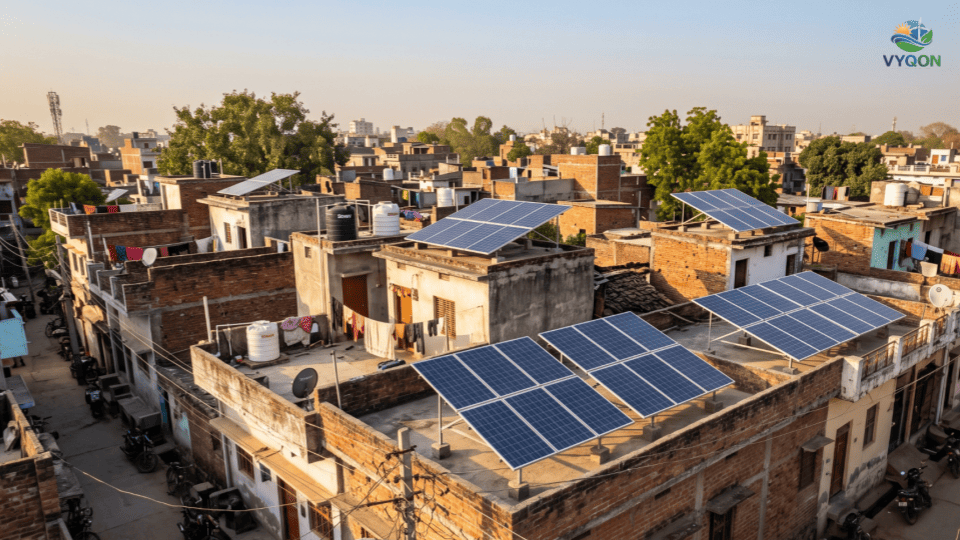
The Bihar Cabinet, chaired by Chief Minister Samrat Choudhary, has approved an estimated expenditure of ₹1,000 crore to provide an additional state-level subsidy for residential rooftop solar installations. This initiative introduces a state “top-up” of ₹10,000/kW to accelerate adoption under the federal PM Surya Ghar: Muft Bijli Yojana. By raising the combined subsidy to ₹98,000 for 3 kW systems, the government aims to solarize 5 lakh households over the next three years. The policy is primarily driven by the need to mitigate Bihar’s high domestic electricity tariffs, which currently range between ₹7.5 and ₹8 per unit, and to close the renewable energy gap with leading states like Gujarat.
Financial Breakdown of Combined Subsidies
The implementation utilizes a “subsidy stacking” mechanism where state financial support is applied over the Central Financial Assistance (CFA). While the federal subsidy scales based on capacity up to 3 kW, the Bihar state top-up is capped at a maximum of ₹20,000 per consumer.
| System Capacity | Central Subsidy (CFA) | Bihar State Top-Up | Total Combined Subsidy |
| 1 kW | ₹30,000 | ₹10,000 | ₹40,000 |
| 2 kW | ₹60,000 | ₹20,000 | ₹80,000 |
| 3 kW | ₹78,000 | ₹20,000 (Capped) | ₹98,000 |
| Above 3 kW | ₹78,000 (Capped) | ₹20,000 (Capped) | ₹98,000 |
Net Metering Economics Beyond the upfront capital subsidy, the long-term financial viability is governed by net metering regulations. According to Bihar Electricity Regulatory Commission (BERC) filings, export rates for surplus energy are approximately ₹3.5–₹4.00 per unit based on the Average Power Purchase Cost (APPC). For a benchmark 3 kW system, which typically costs between ₹2.1 lakh and ₹2.5 lakh, the ₹98,000 support reduces the net out-of-pocket expenditure to ₹1.12 lakh–₹1.52 lakh, resulting in a projected payback period of 3 to 4 years.
Dual-Track Implementation Framework
The state has established two distinct tracks to manage the rollout across different economic segments:
- General Residential Applicants: Under the “General Rail” track, domestic consumers can access the combined subsidy and are eligible for collateral-free loans at interest rates of approximately 7%. Furthermore, all domestic consumers in Bihar—totaling approximately 1.67 crore households—now receive 125 free units of electricity per month under the Mukhyamantri Vidyut Upbhokta Sahayata Yojana, a benefit applied automatically to monthly bills since July 2025.
- Kutir Jyoti / BPL Households: This “Free Solar” pillar targets a massive scale of 58.89 lakh BPL households. For a standard 1.1 kW system costing ₹60,000, the central government provides a ₹33,000 grant, while the Bihar government covers the remaining ₹27,000. This results in zero installation costs for BPL families. These households also benefit from the aforementioned 125 free units monthly, using solar generation to further offset consumption beyond the state-guaranteed waiver.
Operational Model: Utility-Led Aggregation (ULA)
To streamline procurement, Bihar has transitioned to a Utility-Led Aggregation (ULA) model, shifting technical and logistical responsibilities to the DISCOMs.
- The Aggregation Process: North Bihar Power Distribution Company Limited (NBPDCL) and South Bihar Power Distribution Company Limited (SBPDCL) aggregate demand to appoint developers through competitive bidding. The BERC has approved a Phase 1 target of 275 MW for 250,000 consumers under this model.
- RESCO Model and Maintenance: Developers operate under a 10-year framework, providing 5 years of free maintenance. To ensure long-term system reliability across 2.5 lakh rooftops, the state is emphasizing the creation of a “local maintenance champion” network, consisting of trained village entrepreneurs and technicians.
- Technical Requirements: Households must provide a shadow-free rooftop area of at least 64 square feet. The “Har Ghar Solar” mission aims to complete these installations within a three-year window, with initial Phase 1 targets set for November 2026.
Application and Technical Eligibility
The application process is designed to prevent unauthorized intermediary involvement.
- Digital and Physical Access: Consent must be provided via the Suvidha App using a Consumer (CA) Number and OTP verification. For those without digital access, Suvidha counters at divisional offices, Vasudha Kendras, and local camps in districts like Saran and Araria provide assistance. Officials emphasize that the application process is completely free at all official counters; consumers are warned against paying any unauthorized agents.
- Technical Standards: To qualify for the subsidy, solar panels must be Made in India and listed on the Approved List of Models and Manufacturers (ALMM).
Official Statements and Industry Initiatives
Tata Power CEO Praveer Sinha noted that while Bihar possesses a rooftop solar potential of 32 GW, its current peak demand is only 9 GW. To address intermittency and awareness, Tata Power has launched the Mysine battery storage device in Bihar, aimed at reducing reliance on diesel generators. Additionally, the company introduced the “Mera Gaon, Mera Solar” initiative, which provides CSR-funded solar installations for every 100 households in a village.
Compressed Biogas (CBG) Initiative In a separate move to diversify Bihar’s renewable portfolio, the Cabinet approved the provision of 10 acres of land free of cost for 25 years to major oil and gas companies for setting up CBG plants. The assignments are:
- Gaya: Indian Oil Corporation (IOCL).
- Muzaffarpur: Gas Authority of India (GAIL).
- Bhagalpur: Hindustan Petroleum Corporation (HPCL).
- Biharsharif: Bharat Petroleum Corporation (BPCL).
Official Government Sources
- PM Surya Ghar National Portal – The official central government platform for registrations, solar rooftop applications, vendor empanelment, and Direct Benefit Transfer (DBT) subsidy processing.
- Government of Bihar Official Portal – Reference portal for state cabinet decisions, subsidy top-ups, and the Mukhyamantri Vidyut Upbhokta Sahayata Yojana (referenced as
CM Bihar.gov.inin the sources). - Bihar State Power Holding Company Limited (BSPHCL) – The key state-level implementing agency managing the Kutir Jyoti Yojana and regional demand aggregation.
- Bihar Renewable Energy Development Agency (BREDA) – The state nodal agency responsible for coordinating, promoting, and monitoring renewable energy initiatives in Bihar.
- Bihar Electricity Regulatory Commission (BERC) – The regulatory authority responsible for approving tariffs and framework conditions for state solar initiatives.
- North Bihar Power Distribution Company Limited (NBPDCL) & South Bihar Power Distribution Company Limited (SBPDCL) – The state distribution utilities (DISCOMs) executing feasibility checks, net metering, and smart meter installations across Bihar’s northern and southern districts.
Leave a Comment