
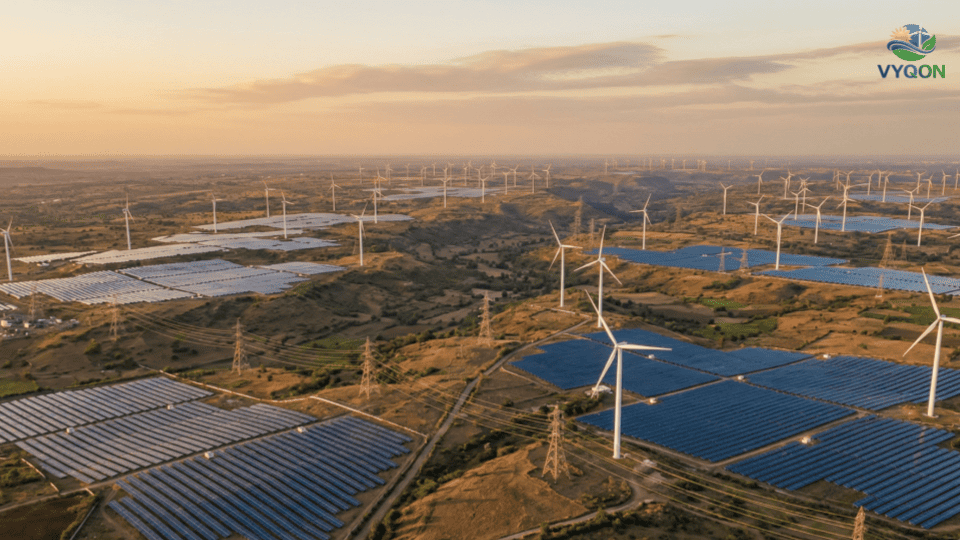
India has secured the third global rank in renewable energy capacity, surpassing Brazil. This transition follows a record addition of 55.3 GW of non-fossil fuel capacity during the 2025-26 financial year.
Global Standing and Ranking Shift
According to the ‘Renewable Energy Statistics 2026’ report issued by the International Renewable Energy Agency (IRENA), India has surpassed Brazil to become the third-largest nation by installed renewable energy capacity. India currently trails China (2,258.02 GW) and the United States (467.92 GW). As of March 31, 2026, India’s total non-fossil fuel power capacity reached 283.46 GW, a figure that encompasses both renewable energy (274.68 GW) and nuclear power.
FY 2025-26 Capacity Breakdown
The capacity growth in the 2025-26 fiscal year was characterized by a record 55.3 GW increase in non-fossil fuel sources. Solar and wind technologies remain the primary contributors to the national energy mix.
| Energy Source | Capacity in Gigawatts (GW) |
| Solar | 150.26 |
| Wind | 56.09 |
| Bio Energy | 11.75 |
| Small Hydro | 5.17 |
| Large Hydro | 51.41 |
| Nuclear | 8.78 |
| Total Non-Fossil Capacity | 283.46 |
Note: Wind energy additions reached a record 6.05 GW during the 2025-26 financial year.
Progress Toward National and International Targets
India achieved the milestone of 50% non-fossil fuel installed electricity capacity in June 2025, reaching this Paris Nationally Determined Contribution (NDC) objective five years ahead of the original 2030 schedule. In July 2025, renewable sources met 51.5% of the total electricity demand, which reached a peak of 203 GW.
Under the commitments announced at COP26, the national target is to establish 500 GW of non-fossil capacity by 2030. The updated NDC for the 2031-2035 period targets 60% of total installed capacity from non-fossil sources and a reduction in emissions intensity of 47% from 2005 levels by 2035.
Domestic Manufacturing and Infrastructure Expansion
Industrial metrics indicate a scaling of domestic manufacturing capacity. Solar module manufacturing capacity reached 172 GW in FY 2026, a year-on-year increase from 74 GW in FY 2025. Wind turbine manufacturing capacity is currently 24 GW.
Government expenditure for FY 2025-26 was recorded at approximately ₹24,176.68 crore, representing 91% of the budget estimate. Regarding market contracting, Power Purchase Agreements (PPAs) are currently in place for 230 GW out of the 275 GW of total installed renewable energy capacity.
Data Attributions and Performance Metrics
Sector performance for the 2025-26 financial year is defined by the following metrics:
- Total electricity generation: 1,845.921 billion units (BU).
- Contribution of non-fossil sources to total generation: 29.2% (538.97 BU).
- Distributed renewable energy: Rooftop solar and the PM KUSUM scheme accounted for 16.3 GW of capacity additions in FY 2025-26.
- Historical multiplier: Solar capacity has increased by a factor of over 53 since 2014.
Leave a Comment