
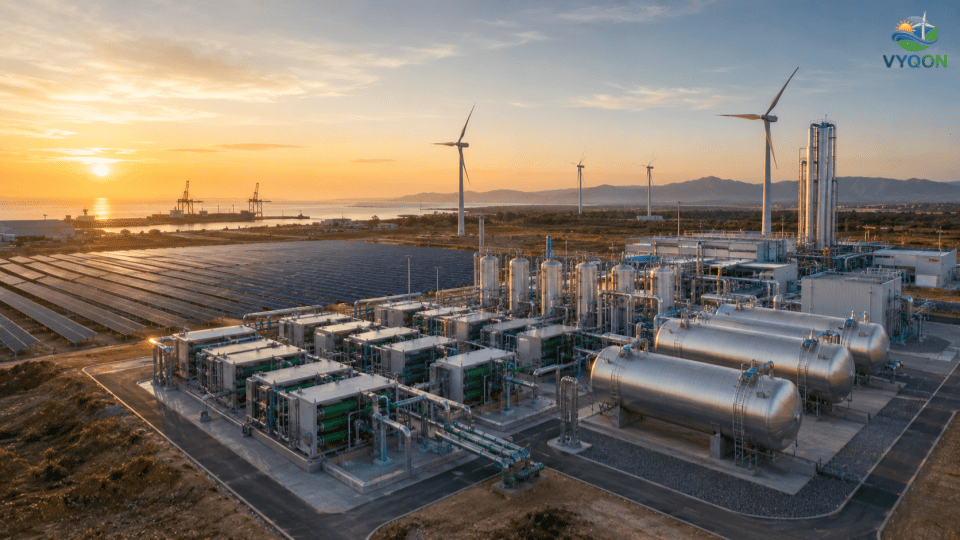
Strong on supply, behind on demand and why the road to 2030 now hinges on a single lever.
When the Union Cabinet approved the National Green Hydrogen Mission (NGHM) in January 2023 with a ₹19,744 crore outlay, it set one of the most ambitious clean-energy targets in the world: at least 5 million tonnes of green hydrogen a year by 2030, with the headroom to reach 10 MMT as export markets develop. Three years in, the Mission is roughly at the halfway mark of its seven-year run — a natural moment to ask a harder question than “how much has been announced?” The real test is whether the announcements are turning into operating plants, lower costs and firm demand.
VYQON Research’s new independent assessment evaluates the Mission against its own 2030 targets across four dimensions — design, implementation, outputs and outcomes — drawing on the Mission Document, SECI’s SIGHT tender results, the MNRE and Ministry of Power annual reports, and official Union Budget data. The short answer: the Mission is a study in contrasts.
The supply side has delivered
On the supply side, the record is genuinely strong. Through the SIGHT programme, India has awarded incentives for roughly 0.86 MMT/yr of green-hydrogen production capacity and 3,000 MW of electrolyser manufacturing, across competitive auctions that were heavily over-subscribed and cleared well below the scheme’s incentive ceiling — a real value-for-money win for the exchequer. Around these awards, the enabling machinery is largely in place: a notified green-hydrogen standard, the GHCI certification framework, a national hydrogen-safety centre, three port-based hubs, four hydrogen-valley clusters, and an active pilot pipeline across steel, mobility and shipping.
The demand side is the binding constraint
The harder questions sit downstream. Commissioned, operating capacity stands at roughly 0.3 MMT/yr — about 6% of the 5 MMT target — even as paper awards reach around 17%. Green hydrogen still costs two to three times the grey hydrogen it must displace, and with electrolyser prices having risen rather than fallen recently, unsubsidised parity now looks likely only in the early-to-mid 2030s — later than the Mission’s own design assumed. Cumulative budget disbursement remains under 4% of the outlay.
The single most consequential gap is demand. The legally-backed consumption obligation — the mechanism, under the Energy Conservation Act, that would require designated consumers to use a minimum share of green hydrogen — has not yet been operationalised. Without firm, mandated offtake, producers carry merchant risk, financing stays expensive, and final investment decisions slow. In short, the Mission was designed as a two-bladed scissor — supply-push incentives and a demand-pull mandate — and so far only the supply blade has moved.
How India compares
Internationally, the contrast is instructive. India has led on supply-push support and arguably extracted better value than more open-ended models elsewhere. But the United States (a per-kilogram production tax credit under 45V) and the European Union (binding RFNBO consumption mandates) have built exactly the demand-pull that India’s own design contemplates but has not yet activated. The strategic gap, in other words, is not ambition or cost-efficiency — it is the demand instrument.
The verdict and the road to 2030
Our assessment rates the Mission strong on design and outputs, and early and lagging on the outcomes that define success. That is not the profile of a failing programme; it is a well-built one that has reached the point where machinery must become market. The decisive variable for 2030 is no longer supply-side ambition but demand creation and project commissioning — above all, pulling the consumption-mandate lever and converting awards into financed, operating plant.
The full report goes well beyond these headlines. It includes a dimension-by-dimension effectiveness scorecard, bidder-level SIGHT tender data, a structured risk register, an international benchmarking comparison, and ten priority recommendations ordered by leverage.
This briefing summarises an independent policy-effectiveness assessment prepared by VYQON Research Pvt. Ltd. It is analytical in nature and does not constitute investment, legal or financial advice.

Leave a Comment