
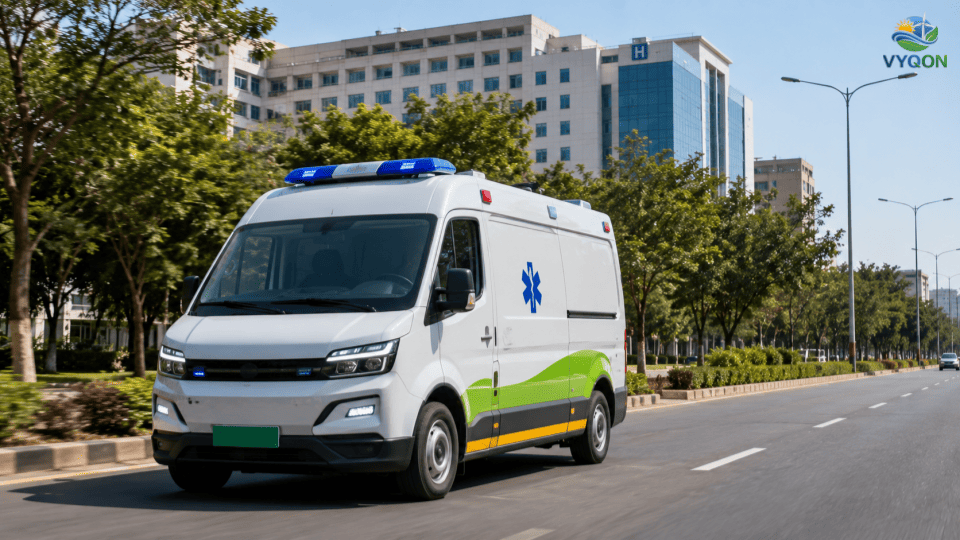
The Ministry of Heavy Industries (MHI) has integrated electric ambulances into the ₹10,900 crore PM E-DRIVE (Electric Drive Revolution in Innovative Vehicle Enhancement) scheme, supported by a dedicated ₹500 crore financial outlay. The primary mission of this segment is to accelerate EV adoption within the medical sector, displacing traditional internal combustion engine (ICE) medical fleets. To address the technical complexities of specialized vehicle development and the long-term lead times required for commissioning testing equipment, the MHI has formally extended the scheme’s terminal date for the e-ambulance, e-truck, and e-bus segments to March 31, 2028.
Financial Allocation and Updated Timeline
The PM E-DRIVE scheme replaces the earlier FAME and EMPS frameworks with a total budget of ₹10,900 crore. While the overarching scheme is fund-limited, the MHI has established distinct temporal boundaries based on segment maturity and commercial production readiness.
- Total Scheme Outlay: ₹10,900 crore.
- Segment-Specific Support: ₹500 crore is explicitly reserved for demand incentives in the e-ambulance category.
- Timeline Extension (2028): The duration for e-ambulances, e-trucks, and e-buses has been extended to March 31, 2028. This adjustment accounts for the “nascent phase” of the e-truck market and the extensive time required for testing agencies to tender, evaluate, and commission specialized equipment.
- Primary Segment Cutoff (2026): The terminal date for e-2W and e-3W remains March 31, 2026.
- Target Volume: While initial estimates varied, the MHI has stated that the maximum number of vehicles to be supported in the e-ambulance segment will be notified separately.
The viability of e-ambulances is underpinned by their high daily utilization rates, typically ranging between 120–200 km. This high mileage makes them an ideal use case for electrification, offering significant reductions in fuel consumption and urban emissions compared to ICE medical transport.
Regulatory and Safety Standards Framework
The technical requirements for e-ambulances are being finalized through a multi-ministry collaboration involving the MHI, the Ministry of Health and Family Welfare (MoHFW), and the Ministry of Road Transport and Highways (MoRTH).
Compliance with the National Ambulance Code (AIS-125) is mandatory. These standards are being refined to ensure patient care requirements are met, specifically regarding vibration resistance, ergonomic access for medical staff, and medical-grade interior LED lighting. Furthermore, eligibility for subsidies hinges on the specific classification of the vehicle. Under current Indian standards (Types 1 through 4), stakeholders are awaiting clarification on whether the scheme will prioritize Type 3 (Basic Life Support) and Type 4 (Advanced Life Support) over Type 2 (Patient Transport) vehicles, the latter of which includes models like the Maruti Suzuki Eeco.
Administrative and Phased Manufacturing Programme (PMP)
To prevent fund leakage and ensure domestic value addition, all vehicles must be registered under the Central Motor Vehicles Rules (CMVR), 1989, and obtain a PM E-DRIVE eligibility certificate from testing agencies such as ARAI or iCAT. Subsidy disbursement is managed through an e-Voucher and Aadhaar-based Face Authentication system. At the point of sale, dealers perform face modality authentication of the buyer to generate a unique e-Voucher, which is then signed by both parties to facilitate OEM reimbursement.
The following Phased Manufacturing Programme (PMP) categorizes the localization mandates:
| PMP Localization Requirements | Components |
| Domestic Sourcing Mandate | HVAC systems, traction battery packs, charging inlets, electric compressors for brakes, and vehicle control units (VCU). |
| Temporary Import Window (Until March 31, 2026) | Traction motors fitted with rare earth magnets, battery management systems (BMS), and DC-DC converters. |
The temporary import window for rare earth magnets is tied to the government’s parallel ₹7,280 crore initiative aimed at establishing domestic magnet manufacturing facilities, intended to de-risk the supply chain from global export controls.
Industry Participation and Technical Homologation
Industry readiness is in a nascent but active phase. In June 2025, Force Motors achieved the first technical homologation for an electric ambulance model, a critical regulatory step prior to commercial rollout.
Other key participants include:
- Tata Motors: Has provided written expression of interest to the MHI, though officials note that discussions remain at a nascent stage.
- Maruti Suzuki India (MSIL): Is exploring the hybrid segment for medical transport. Notably, e-ambulances are a unique category under PM E-DRIVE where hybrid and strong hybrid models are eligible for support. However, MSIL’s participation remains contingent on whether the final guidelines include Type 2 ambulances.
- EKA Mobility: Has expressed interest in the segment but is awaiting the release of final operational guidelines and subsidy figures before committing to specific production volumes.
Commercial production across the sector is expected to commence following the notification of specific eligibility criteria and subsidy amounts, with OEMs currently adapting existing vehicle architectures to handle the rigorous demands of emergency medical services.
Leave a Comment