
Notification Details
The Karnataka Electricity Regulatory Commission (KERC) has issued the Draft Electricity Supply Regulations (ESR), 2026 under Notification No. KERC/DDD/ESR/2026-27/2376, dated August 14, 2026. This omnibus regulatory update establishes a unified framework for Distribution Licensees in Karnataka, governing the lifecycle of the consumer-utility relationship—from new service connections and metering to billing accuracy and disconnection protocols. Stakeholders and the public have been granted a 30-day window from the date of notification to submit suggestions and objections.
Consolidation Scope and Regulatory Intent
The 2026 draft seeks to streamline and modernize the state’s electricity supply architecture to ensure transparent, reliable, and consumer-centric service. Critically, these regulations—alongside the proposed General Network Access (GNA) framework—are designed to replace the 2022 Green Energy Open Access (GEOA) framework, which was previously struck down by the Karnataka High Court for lack of alignment with the National Electricity Policy.
The regulatory intent is to bridge the gap between legacy transaction-based models and the demands of a high-renewable grid. The scope covers technical quality standards, grid reliability, and formal legal mechanisms to address unauthorized electricity use and consumer disputes.
Electricity Connections and Metering Standards
The draft introduces rigorous procedural requirements to minimize utility delays and align with digital infrastructure trends:
- Streamlined Timelines: Utilities are mandated to inspect and commission completed service connections within five working days of receiving a work completion report for projects up to 150 kW.
- Procedural Penalties: Failure by utility personnel to meet the five-day commissioning timeline will attract a penalty of INR 1,000 per day, payable to the applicant.
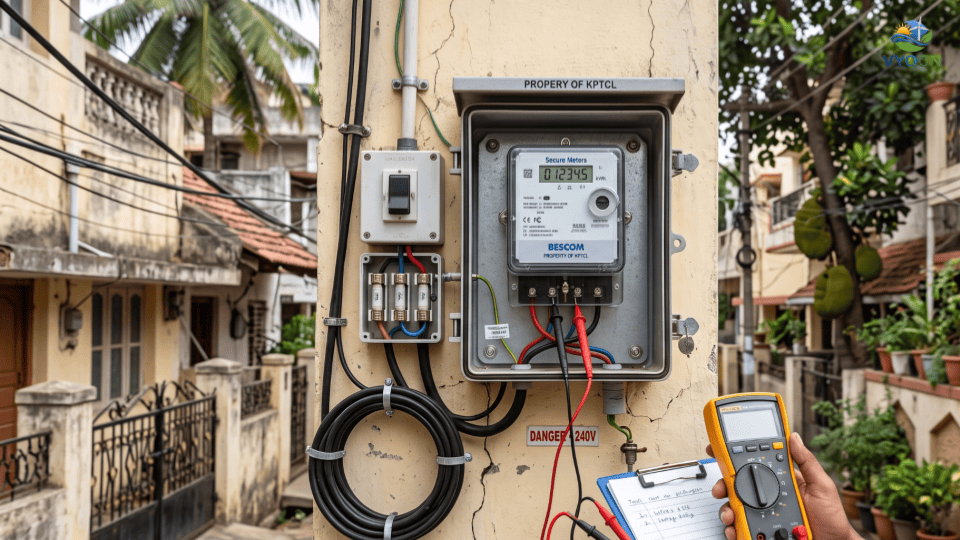
- Smart Metering: The framework mandates advanced digital metering infrastructure and bidirectional smart meters for the majority of new installations to support real-time data integration.
- Consumer Obligations: Consumers must maintain installations according to safety standards and are legally required to provide utility personnel access for meter reading and safety inspections.
Billing, Consumer Standards, and Grievance Redressal
KERC has proposed standardized benchmarks for the commercial interface to reduce the ambiguities that lead to litigation:
- Billing Integrity: The draft details strict billing cycles and accuracy standards, including the mandatory settlement of final bills upon disconnection of service.
- Commercial Norms: The regulations outline the legal procedures for disconnection, norms for security deposits, and the prerequisites for service reconnection.
- Redressal Mechanisms: Formal grievance redressal channels are established, requiring utilities to maintain transparent records and provide time-bound resolutions to consumer complaints.
Integration of Renewable Energy and General Network Access (GNA)
A central pillar of the 2026 reform is the transition from transaction-based open access to a capacity-based GNA framework. This separates “connectivity” (the physical infrastructure) from “access” (the commercial right to inject or draw power).
Eligibility Thresholds for Connectivity and Access
| Access Level | Category | Threshold/Mechanism |
| Transmission (InSTS) | Generating stations, RE Projects, Storage (BESS/PSP) | 5 MW and above |
| Distribution | C&I Consumers | 100 kW or above (Contract Demand) |
| Temporary Access | T-GNA | Short-term transactions via SOAR |
Commercial and Operational Constraints:
- GNA Relinquishment: In a significant shift toward long-term planning, GNA relinquishment requires a one-year notice period and is subject to variable relinquishment charges based on the duration of network usage.
- Banking Provisions: Monthly banking of renewable energy is permitted until March 31, 2030. Banking charges are set at 8% of banked energy, payable in kind.
- Standby Charges: Open access consumers utilizing standby power will be charged at 125% of normal energy rates, though this premium is avoidable if a 24-hour advance notice is provided to the licensee.
- Regulatory Management: Short-term access (T-GNA) will be managed through the State Open Access Registry (SOAR), an electronic platform managed by the State Load Despatch Centre (SLDC).
Distributed Solar Photovoltaic (DSPV) and Storage Mandates
The draft officially renames the “Solar Rooftop” framework to “Distributed Solar Photovoltaic” (DSPV), expanding the definition to include facade-integrated systems and elevated ground-mounted structures.
- Engineering Constraints: To preserve grid health, DSPV systems below 150 kW are capped at 80% of the local distribution transformer capacity.
- Mandatory Storage: To mitigate solar intermittency, systems above 10 kW must incorporate hybrid inverters or battery storage equivalent to 20% of the plant’s capacity.
- Behind-the-Meter (BTM) Security: For BTM arrangements meant exclusively for self-consumption, the installation of reverse power flow relays is mandatory to prevent inadvertent injection into the distribution grid.
- Procedural Exemptions: For projects up to 150 kW, the requirement for a formal Power Purchase Agreement (PPA) is waived, and consumers are eligible for “Deemed Generation” benefits if utilities delay commissioning.
- Compensation Logic:
- Net Metering: Capped at 500 kW; restricted to domestic and charitable categories.
- Net Billing: Consumers pay retail tariffs for grid imports and receive a KERC-determined tariff for exports.
Demand Flexibility and Grid Management (DSM)
To address peak demand shortages, KERC has introduced Demand Side Management (DSM) obligations for utilities:
- Portfolio Obligations: Utilities must achieve demand flexibility equivalent to 0.5% of peak demand for FY 2026–27, rising to 2.0% by FY 2029–30.
- Financial Accountability: Performance is linked to an incentive/penalty of INR 0.20 crore per MW.
- Implementation Infrastructure: Distribution licensees are required to establish Dedicated DF and DSM cells and utilize Independent Verification Agencies to confirm energy savings.
Stakeholder Consultation and Next Steps
The proposed Electricity Supply Regulations, 2026 are scheduled to take effect on October 1, 2026. Following the 30-day public comment window starting August 14, 2026, the KERC may convene public hearings to finalize the text.
Upon final notification, the STU and distribution licensees must develop and publish detailed operational procedures within 60 days. This framework will repeal the 2025 Open Access regulations and the 2016 Solar Rooftop regulations, completing the transition to a capacity-based, storage-integrated distribution model.
Official Regulatory Sources & Publications
- Draft Karnataka Electricity Regulatory Commission (Electricity Supply) Regulations, 2026
- Notification Reference: No. KERC/DDD/ESR/2026-27/2376
- Issuing Authority: Karnataka Electricity Regulatory Commission (KERC)
- Publication Date: 14 August 2026
- Official Portal: KERC Official Portal
- Gazette Document Access: Draft ESR 2026 Gazetted Text
- Draft KERC (Connectivity and General Network Access to the Intra-State Transmission System and State Distribution System) Regulations, 2026
- Issuing Authority: Karnataka Electricity Regulatory Commission (KERC)
- Publication Date: 4 June 2026
- Official Portal: KERC Official Portal
- Regulatory Tracker Details: Draft GNA Regulations 2026 Framework
- Framework for Demand Flexibility (DF) and Demand Side Management (DSM) Regulations, 2026
- Issuing Authority: Karnataka Electricity Regulatory Commission (KERC)
- Notification Date: 24 March 2026
- Official Portal: KERC Official Portal
- Regulatory Tracker Details: Demand Flexibility & DSM Framework 2026
- Draft Grid Interactive Distributed Solar Photovoltaic (DSPV) Plants Regulations, 2026
- Issuing Authority: Karnataka Electricity Regulatory Commission (KERC)
- Publication Date: 6 June 2026
- Official Portal: KERC Official Portal
- Regulatory Tracker Details: Draft DSPV Regulations 2026 Framework
- Draft Amendments to the Karnataka Electricity Supply Code
- Issuing Authority: Karnataka Electricity Regulatory Commission (KERC)
- Publication Date: 20 February 2026
- Official Portal: KERC Official Portal
- Regulatory Tracker Details: Draft Electricity Supply Code Amendments 2026
Leave a Comment