
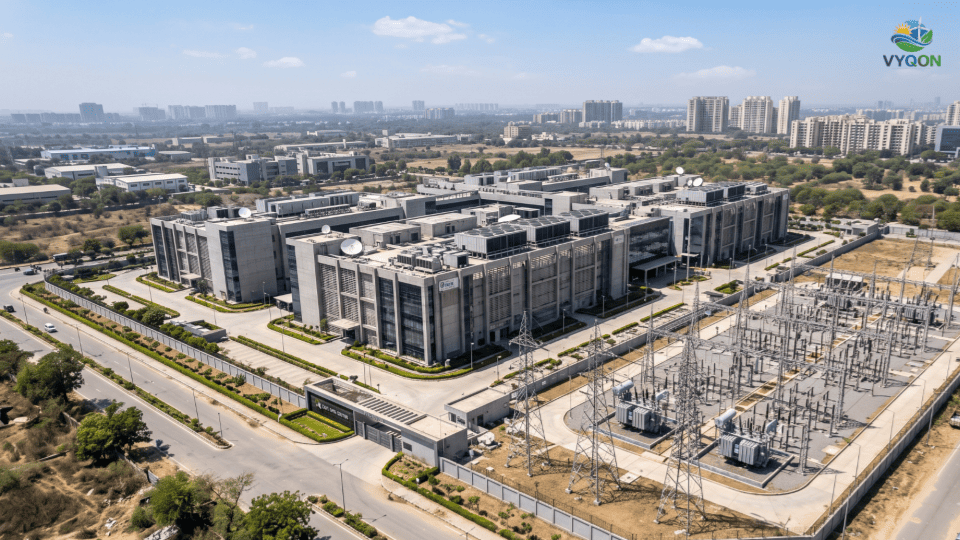
The Uttar Pradesh Electricity Regulatory Commission (UPERC) has formally admitted a petition from Adani Energy Solutions Step Eleven Limited seeking a parallel electricity distribution license for the Noida Data Center Park. While the August 5 order marks a procedural advancement, the Commission has specifically flagged the petition as being “against government norms” due to a failure to meet minimum area requirements. UPERC has now invited stakeholders to submit objections or suggestions within one month of the draft proposal’s publication, signaling a critical regulatory juncture for the state’s high-value industrial power corridor.
Petition Details and Regulatory Provisions
The regulatory process involving Adani Energy Solutions Step Eleven Limited—closely linked to Adani Electricity Jewar Limited and Adani Transmission Limited—is navigating a complex legal framework. The petition is filed under Sections 14 and 15 of the Electricity Act 2003, which currently requires parallel licensees to construct and maintain their own independent distribution networks.
However, UPERC has signaled significant friction regarding the “minimum area” provisions established by the Central Government. In a previous hearing involving the wider Jewar and Noida applications, the Commission noted that the group’s request targeted only specific urban pockets, which contradicts the mandatory geographic scope required for private entry.
Minimum Area Requirements:
- Three-District Mandate: Per the Central Government’s November 28, 2022 gazette, private distribution applicants must generally apply for an area covering at least three adjoining revenue districts.
- Urban Specification: Alternatively, applications may cover specific municipal corporations or urban areas as notified by the Appropriate Government.
- Regulatory Scrutiny: UPERC specifically sought a reply from the petitioner regarding why the application—covering only two urban areas—should not be dismissed for non-compliance with the three-district rule.
The Noida Data Center Park: Project Scope
The proposed license targets the Noida Data Center Park, a region rapidly emerging as a primary hub for multinational data centers and High Tension (HT) industrial sales. This area is considered a “prime” zone for private licensees due to its concentrated demand and high revenue efficiency.
The regulatory landscape in this zone is already fraught with litigation. The incumbent, Noida Power Company Limited (NPCL), recently moved the Supreme Court to continue its operations. Notably, NPCL’s service term was set to expire in August 2023, a condition that theoretically necessitates the transfer of the distribution network to the state-owned Paschimanchal Vidyut Vitran Nigam Limited (PVVNL). Adani’s bid seeks to capitalize on this transitional period, following the factual precedent set by NIDP, which already operates as a parallel licensee for a specific data center in Greater Noida.
Stakeholder Opposition and Financial Concerns
The Vidyut Karmachari Sanyukt Sangharsh Samiti and the Uttar Pradesh State Electricity Consumer Council (UPSECC) have mounted a robust defense against the petition. Their primary concern is the potential for “cherry-picking,” where private players siphon off the most profitable industrial consumers, leaving the state utility with the financial burden of serving low-revenue rural and residential sectors.
Key Stakeholder Objections
| Power Employees (Sangharsh Samiti) | Consumer Representatives (UPSECC) |
| Describe the move as “privatization by stealth” aimed at systematically weakening PVVNL. | Focus on the erosion of the cross-subsidy mechanism that funds lower tariffs for small/rural consumers. |
| Warn that private operators intend to leverage state-funded infrastructure to serve only high-value industrial clusters. | Argue that “cherry-picking” high-revenue HT consumers will lead to tariff hikes for ordinary residential users. |
| Argue that the petition sets a dangerous precedent for the fragmentation of the state distribution network. | Demand that UPERC mandate the recovery of massive public investments already made in the existing state grid. |
UPSECC Chairman Avadhesh Verma has urged the Commission to reject the proposal, citing the risk to the financial stability of state DISCOMs. He highlighted that losing high-revenue multinational consumers would severely impair the utility’s ability to maintain its Universal Service Obligation (USO) across less profitable districts.
National Regulatory Landscape and Future Implications
The UPERC case is a “canary in the coal mine” for the proposed Electricity (Amendment) Bill 2025. While the current Adani petition is filed under existing laws requiring a separate physical network, the upcoming Bill seeks to dismantle this barrier in favor of shared infrastructure.
Legal Effects of the Proposed Bill 2025:
- Shared Distribution Systems: The Bill modifies Section 14 to enable competition through “shared networks,” removing the capital-intensive requirement for each licensee to build separate wiring.
- Statutory Duty of Open Access: Incumbent licensees would face a mandatory, non-discriminatory duty to provide network access to competitors upon payment of wheeling charges, narrowing the incumbent’s operational autonomy.
- Shift in Supply Obligations: Section 43 may be modified to exempt licensees from the duty to supply consumers above 1 MW, potentially creating a tiered market that excludes large industrial loads from the standard USO.
This trend toward targeting high-value HT Industrial and Commercial sales is already evident in Maharashtra. In the Thane and Vashi areas—where Adani and Tata Power have applied for parallel licenses—the proposed areas constitute approximately half of total MSEDCL sales and a staggering two-thirds of all HT sales in the state. Experts warn that a heavy reliance on short-term power sources in these competitive bids could lead DISCOMs to fail their Resource Adequacy (RA) obligations.
Verified Regulatory Facts
- Operational Efficiency: The Noida and Greater Noida regions report a low line loss rate of 9-10%, making them significantly more profitable than the state average.
- Financial Risk Scale: Illustrating the stress of sales migration, MSEDCL in Maharashtra currently faces the recovery of Rs. 28,000 crore in regulatory assets, a burden that would fall on remaining consumers if high-value sales are lost.
- USO Technical Strategy: Adani’s technical proposal suggests a tiered USO rollout, declaring 33/22 kV or 11 kV networks USO-compliant for larger industrial areas while limiting Low Tension (LT) residential USO to small, localized pockets.
- NPCL Status: NPCL’s service term expiration and subsequent Supreme Court intervention remain the primary legal hurdles for defining the “incumbent” status in the Noida region.
Official Regulatory & Government Sources
1. Uttar Pradesh Electricity Regulatory Commission (UPERC)
- Official Databases:
- UPERC Orders Portal — Official repository for commissions, decisions, and formal orders.
- UPERC Notices Portal — Official notices of hearings and admissions.
- Noida Sector 62 Data-Center Park Case Files (Petition No. 2333 of 2025):
- UPERC Commission Order (dated 5 August 2026) — Order directing the public-notice process and defining the preliminary boundary limits of the parallel distribution licence application.
- UPERC Notice of Admission (dated 24 July 2026) — Official hearing notice admitting the petition.
2. Ministry of Power, Government of India
- Legislation & Scheme Policies:
- The Electricity Act, 2003 — The statutory framework enabling parallel distribution licensing under Section 14.
- Ministry of Power Office Memorandum — Official guidelines on rural infrastructure development and feeder separation under the Deendayal Upadhyaya Gram Jyoti Yojana (DDUGJY).
3. Central Electricity Authority (CEA)
- National Power Sector Planning:
- National Electricity Plan (Generation) – January 2018 — National capacity addition targets, generation planning, and retirements.
- CEA Monthly Executive Summary (March 2017) — Data on installed capacity and power generation metrics.
- CEA Monthly Executive Summary (March 2007) — Historical baseline data on power distribution and capacity metrics.
4. Maharashtra Electricity Regulatory Commission (MERC)
- Case Decisions & Tariff Regulations:
- MERC Suo Moto Order (Case No. 42 of 2017) — Regulatory review of the status and requirements of upcoming state-level generation projects.
- MERC Multi-Year Tariff Order (Case No. 48 of 2016) — True-up and Multi-Year Tariff order for the third control period.
Leave a Comment