
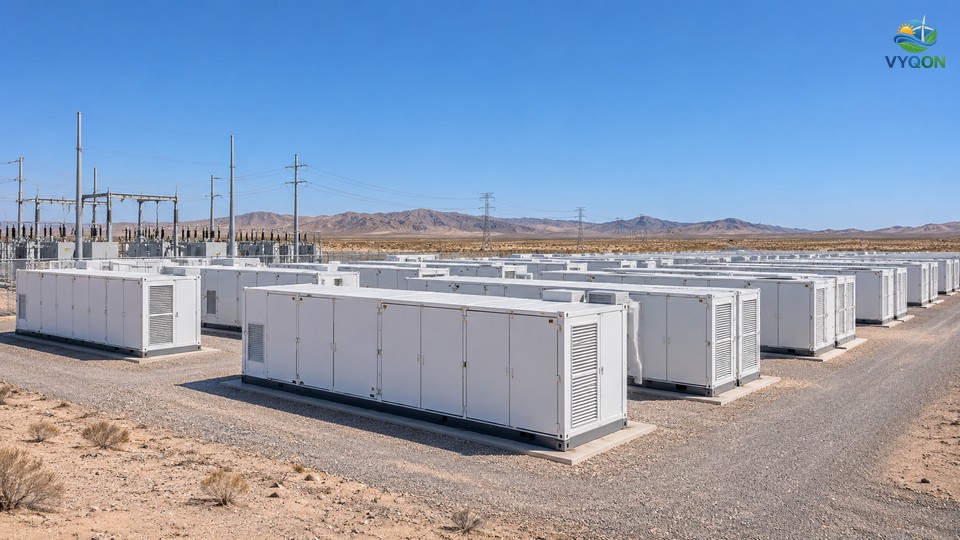
The Rajasthan High Court has quashed a retrospective 20% local-content requirement that Rajasthan Rajya Vidyut Utpadan Nigam Limited (RVUNL) imposed on 11 developers of its 500 MW/2,000 MWh standalone battery energy storage system (BESS) tender. In a judgment of 18 November 2026, Justice Anand Sharma of the Jaipur Bench allowed all 11 writ petitions, ruling that the extra condition cannot be applied retrospectively to these petitioners under Letters of Award (LoAs) that were already issued and accepted. The ruling is a notable one for the Rajasthan High Court BESS dispute and for storage developers across India.
What the court decided
The lead case is S.B. Civil Writ Petition 16017/2026, filed by MIPHI Semicon India Private Limited, a subsidiary of Micromax Informatics Limited. Ten connected petitions were heard with it, including Writ Petition 7761/2026 filed by Ultravibrant Integrated Energy. The judgment carries the neutral citation 2026:RJ-JP:46365 and is marked reportable. The respondents were the State of Rajasthan, the Union of India through the Ministry of Power, RVUNL, the Rajasthan Electricity Regulatory Commission (RERC), Rajasthan Rajya Vidyut Prasaran Nigam (RVPN), the Rajasthan Renewable Energy Corporation (RRECL) and Rajasthan Urja Vikas and IT Services Limited (RUVITL).
In the operative part of the order (paragraph 88), the court:
- allowed all 11 writ petitions;
- quashed the RVUNL communication of 7 January 2026 to the extent that it imposes the 20% local-content requirement, including the requirement for indigenous energy management system (EMS) software;
- declared that this requirement cannot be applied retrospectively to these petitioners under already awarded and accepted LoAs, in the facts of the case;
- quashed RVUNL’s notice of 10 April 2026 to the same extent;
- directed that RVUNL must not cancel the allotted BESS capacity or forfeit bid security solely because a petitioner did not give the undertaking or did not meet the extra requirement.
The court also kept the petitioners bound by the original terms. They remain bound by the original Request for Selection (RfS) and LoA, which means they must furnish the performance bank guarantee or surety bond and sign the Battery Energy Storage Purchase Agreement (BESPA) within 15 days of receiving a certified copy of the judgment. The tariff adoption orders of RERC were not disturbed.
How the Rajasthan High Court BESS dispute arose
RVUNL’s tender was for a 500 MW/2,000 MWh standalone BESS in Rajasthan, which implies a four-hour storage duration. The LoAs to the successful bidders are dated 19 December 2025. According to the judgment, neither the RfS, nor the bidding conditions, nor the LoAs contained a minimum 20% local-content condition or a requirement for indigenous EMS software.
The requirement came later. A Ministry of Power letter dated 24 December 2025, issued five days after the LoAs, introduced the local-content condition. RVUNL then wrote to the awardees on 7 January 2026 imposing it, and on 10 April 2026 issued a notice threatening action against those who did not comply. The developers challenged the added condition in the High Court, and the court held that, for these petitioners and on these facts, it could not be applied.
Scope of the ruling
The ruling is narrow, and it should be read that way. It covers the 11 petitioners and the LoAs they hold under this tender. The court did not strike down the Ministry of Power’s local-content rule in general, and it did not rule on whether such a requirement can be included in future tenders from the start. The judgment says the requirement cannot be applied retrospectively to these petitioners, in the facts of the case. The status of any appeal is not stated in the judgment and is not covered here.
What it means for India’s clean-energy sector
India’s battery storage market is moving quickly, with state utilities and central agencies inviting bids for standalone BESS capacity on tariff-based competitive terms. Developers price such bids on the basis of the conditions published in the RfS, including the supply chain they can use for cells, power conversion systems and software. A condition that appears after the award, and that would need a different equipment mix, can change project costs and delivery timelines.
For developers, the judgment supports the principle that the terms of an RfS and an accepted LoA are the basis on which a project proceeds. For state utilities and policymakers, it shows that local-content requirements are more secure in legal terms when they are part of the tender documents from the start. The ruling also keeps the Rajasthan project moving: the petitioners now have a clear timeline of 15 days from receipt of the certified copy to furnish the performance guarantee or surety bond and sign the BESPA, and RVUNL cannot cancel capacity or forfeit bid security solely over the disputed requirement.
Rajasthan is one of India’s largest solar states, and storage connected to its solar fleet is expected to help shift daytime generation into the evening peak. Clarity on the contract terms for the 500 MW/2,000 MWh tender removes one source of uncertainty for projects that are meant to support that role.
Official references
1. High Court of Judicature for Rajasthan, Bench at Jaipur, judgment of 18 November 2026 in S.B. Civil Writ Petition No. 16017/2026, MIPHI Semicon India Private Limited vs State of Rajasthan and others, with connected petitions (neutral citation 2026:RJ-JP:46365; 69 pages; web copy): https://lawsandlegals.com/wp-content/uploads/2026/11/181126-RJ-ULTRAVIBRANT-INTEGRATED-REPO-AS-JAIP-S26NO111.pdf
Leave a Comment