
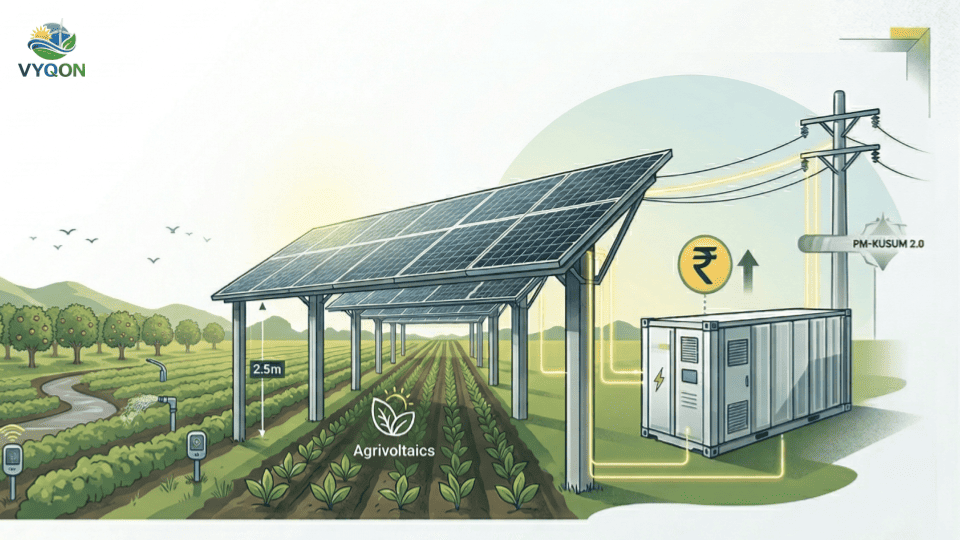
Introduction: The Strategic Revamp of Agricultural Energy
The transition from PM-KUSUM 1.0 to the revamped 2.0 framework represents far more than a policy extension; it is a fundamental structural realignment designed to de-risk the Indian power sector. With accumulated DISCOM losses reaching ₹7.08 lakh crore and growing at 8% per annum, the traditional model of subsidized agricultural power has reached a breaking point. For investors and developers, PM-KUSUM 2.0—backed by a budget expansion to nearly ₹50,000 crore—is a survival necessity for the grid and a massive commercial opportunity.
As we approach the March 31, 2026 sunset date for the initial phase, the 2.0 framework pivots from hardware-centric deployment to a technically robust ecosystem. By integrating Battery Energy Storage Systems (BESS) and a dedicated 10 GW Agrivoltaics (Agri-PV) mandate, the Ministry of New and Renewable Energy (MNRE) is solving the legacy hurdles of land scarcity and “hosting capacity” exhaustion that previously hindered decentralized solar.
Land Optimization: Solving the Acquisition Hurdle via Agrivoltaics
Land acquisition remains the primary friction point for rural solar. PM-KUSUM 2.0 addresses this through Agrivoltaics, using stilt-mounted solar arrays to enable simultaneous energy generation and crop cultivation. Crucially, the policy now recognizes Agri-PV as an agricultural activity, effectively bypassing the complex and politically sensitive land-conversion clearances that stalled projects in the past.
For institutional investors, the strategic move is to partner with Farmer Producer Organizations (FPOs) and cooperatives. These entities serve as the bridge for land aggregation and PPA negotiation, turning fragmented holdings into bankable utility-scale feeders.
Agri-PV: The Dual-Income Advantage
| Metric | Impact / Strategic Value |
| National Technical Potential | 3,156 GW to 13,803 GW (Unlocking vast underutilized acreage) |
| Direct Farmer Income | Increase from ₹60,000 (Rain-fed baseline) to >₹1,00,000 per acre/year |
| Resource Efficiency | 15% to 25% reduction in soil moisture evaporation |
| Revenue Model | Combined sale of crops and electricity (₹48 lakh to ₹54 lakh per MW/year) |
Grid Resilience: BESS as the Stabilizer for Rural PPAs
The integration of Battery Energy Storage Systems (BESS) is the most critical technological update in the 2.0 roadmap. Without storage, the grid’s “hosting capacity” for intermittent solar at the distribution edge would be exhausted, leading to frequent curtailment. BESS transforms agricultural feeders from passive, unstable loads into dispatchable, flexible assets.
By enabling “load shifting,” BESS allows DISCOMs to store surplus daytime solar and discharge it during evening irrigation cycles. This stability protects the reliability of Power Purchase Agreements (PPAs) by allowing DISCOMs to avoid expensive peak-hour procurement, which currently costs between ₹6 and ₹10 per unit.
Technical Suitability & Compliance (IS 16270:2023) Strategic deployments must adhere to the latest safety standards, with a focus on high-temperature resilience for regions like Rajasthan where ambient heat exceeds 50°C.
- Lithium Iron Phosphate (LFP): The industry benchmark for grid-connected systems (e.g., UnityESS). It is preferred for its high cycle life and safety, requiring liquid cooling and flame-retardant casings to prevent thermal degradation.
- Lead-Acid (Vented/VRLA): Only suitable for smaller, standalone Component B pump systems due to shorter lifespans and limited depth of discharge.
- Nickel-Cadmium (NiCd): Reserved for extreme industrial rural environments requiring high-strength, alkali-resistant containers, though often cost-prohibitive for standard FLS.
Financial Framework: From Subsidies to Asset-Based Investments
The fiscal environment has shifted toward ensuring long-term project bankability. A major CAPEX driver for BESS is the nine-fold increase in Viability Gap Funding (VGF), rising from ₹100 crore to ₹1,000 crore, alongside Basic Customs Duty (BCD) exemptions for lithium-ion cell manufacturing capital goods. Developers can further leverage the Agriculture Infrastructure Fund (AIF) for low-interest, long-tenure loans.
To secure Central Financial Assistance (CFA), investors must focus on projects with “firm commitments”—defined as PPAs signed by December 31, 2025.
Revised Timelines for Project Security
| Project Category | Financial Closure Deadline | Commissioning Deadline |
| Component A & C (Feeder-Level) | September 30, 2026 | March 31, 2027 |
| Component B & C (Individual Pump) | N/A | September 30, 2026 |
Navigating Technical and Operational Complexity
The shift to PM-KUSUM 2.0 introduces technical nuances that demand specialized consultancy to maintain a target Capacity Utilization Factor (CUF) of 19% to 22%.
- Active Grid Orchestration: Standard transformers are incapable of handling bi-directional flows and high-frequency “switching noise.” We specify “Inverter Duty” transformers featuring electrostatic shields, hermetic sealing, and high-temperature ester fluids (replacing mineral oil) to survive 50°C+ environments. Integrating IoT-enabled sensors allows for real-time load orchestration.
- CUF Recovery via Robotic O&M: In arid zones, dust soiling can cause 15% generation losses. While manual cleaning costs ₹1.2 per panel and consumes up to 12 tons of water per MW, robotic cleaning reduces costs to ₹0.20 per panel and achieves a 95% recovery of soiling losses.
- PAR Optimization: Consultants must optimize panel tilt to balance PV yield with Photosynthetically Active Radiation (PAR) requirements, ensuring crop yields are not compromised by the solar canopy.
Conclusion: The 2030 Vision for “Prosumer” Farmers
PM-KUSUM 2.0 redefines the farmer’s role from a passive consumer to a “prosumer”—a critical partner in India’s 500 GW non-fossil fuel goal. With commissioned plants offering an annual revenue potential of ₹48 lakh to ₹54 lakh per MW (median ₹4.5 lakh/MW/month), the scheme provides a globally unique model for food and energy security.
The policy window is narrow. Stakeholders must move immediately to achieve financial closure by September 30, 2026, to capitalize on the current fiscal incentives and the fundamental realignment of India’s rural infrastructure.
Leave a Comment