
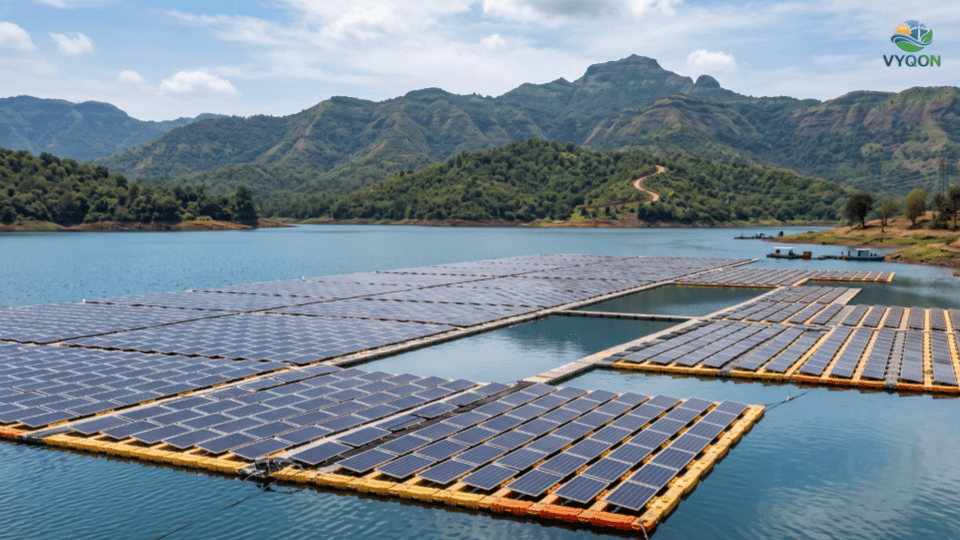
- Capacity: 115 MW Floating Solar PV project integrated with a co-located Battery Energy Storage System (BESS).
- Location: Manjara Dam reservoir, situated in Kaij Taluka, Beed district.
- Submission Deadline: September 2, 2026, at 6:00 PM.
- Development Model: Lease-Develop-Operate-Transfer (LDOT) framework under a Public-Private Partnership (PPP) structure.
- Concession Period: Envisaged as 25 years from the Commercial Operation Date (COD).
In a strategic push to align water resource management with renewable energy expansion, the Water Resources Department of the Government of Maharashtra has issued an invitation for Expressions of Interest (EOIs) to develop 115 MW of floating solar capacity at Manjara Dam. The tender, issued through the Office of the Executive Engineer, Latur Irrigation Division No. 1, represents a high-priority infrastructure project that integrates large-scale power generation with advanced energy storage.
The project is designed as a multi-purpose utility initiative. While the primary focus remains the generation of clean energy and grid stabilization via BESS, the state is pursuing a dual-use strategy for the reservoir. Simultaneously, the Godavari Marathwada Irrigation Development Corporation (GMIDC) is inviting interest in leasing designated areas of the reservoir surface for fisheries and aquaculture, highlighting a holistic approach to maximizing the economic utility of state-owned water bodies.
Project Scope and Technical Specifications
The project developer will be responsible for the comprehensive lifecycle of the facility, including financing, design, supply, installation, and commissioning, followed by long-term operation and maintenance.
- BESS Integration and Sizing Flexibility: Adhering to the “Maharashtra Renewable Energy and Energy Storage Policy 2025-26 to 2035-36,” the project must meet a mandatory storage requirement of 50% of the solar capacity with a minimum discharge duration of two hours. This establishes a baseline of 1 MWh of storage per 1 MW of connectivity. However, providing critical technical flexibility for developers, the policy allows for variable sizing of the BESS provided the minimum power rating of the BESS is not less than 25% of the RE project connectivity.
- Operational Mandate: The project will be executed under the Lease-Develop-Operate-Transfer (LDOT) model. Given the targeted Commercial Operation Date (COD) of FY 2028-29, the system must be fully operational with the integrated storage component at the time of commissioning. Proportional BESS capacity must be commissioned alongside any phased solar installations to ensure continuous policy compliance.
Tender Timelines and Submission Process
The procurement schedule for the Manjara Dam project is as follows:
| Event | Date and Time | Location/Details |
| Document Download/Clarification Start | August 13, 2026, at 11:00 AM | Maharashtra e-tendering portal |
| Deadline for Seeking Clarifications | August 19, 2026, at 6:00 PM | Online Portal |
| Pre-bid Meeting | August 20, 2026, at 12:00 PM | Office of Chief Engineer, CAD, Nanded |
| Bid Submission Deadline | September 2, 2026, at 6:00 PM | Maharashtra e-tendering portal |
| Technical Bid Opening | September 4, 2026, at 3:00 PM | Executive Engineer’s Office, Latur |
Interested participants must access all necessary documentation and submit their proposals through the Government of Maharashtra’s official e-tendering portal.
- Maharashtra Government e-Procurement Portal: This is the official unified platform where the Expression of Interest (EOI) and standard bidding booklets are hosted, and where empanelled developers must register to check bidding status and submit proposals.
- Latur District Official e-Tender Page: The district administration’s dedicated portal providing localized e-procurement guidelines, standard bidding procedures, and regional tender notices.
- Maharashtra Water Resources Department Portal: The parent administrative department portal of the Government of Maharashtra, which oversees the Godavari Marathwada Irrigation Development Corporation (GMIDC)—the issuing authority for the Manjara Dam project.
Eligibility and Financial Criteria
The Water Resources Department is targeting empanelled bidders and experienced private-sector concessionaires with the technical and financial bandwidth to execute complex floating solar infrastructure.
- Qualification Standards: Bidders must demonstrate a proven track record in renewable energy development and satisfy the financial capability requirements detailed in the full EOI documents.
- Security and Validity: Proposals must remain valid for 180 days from the opening date. While the specific Earnest Money Deposit (EMD) and Performance Bank Guarantee amounts are contingent on final project valuations, they are governed by the detailed terms within the EOI.
- Strict Compliance: Conditional bids are strictly prohibited. The department maintains the absolute right to reject proposals that deviate from the stipulated framework or to cancel the process without prior justification.
Policy Context and Industry Background
This tender serves as a major implementation milestone for the “Maharashtra Renewable Energy and Energy Storage Policy 2025-26 to 2035-36.” The policy targets a 65% renewable energy share by FY 2035-36 and sets a cumulative state-wide storage target of 100 GWh—the most ambitious sub-national storage mandate in India.
Industry analysts view the Manjara Dam project as a critical “litmus test” for the state’s ability to overcome historical hurdles in the floating solar sector. Previous initiatives, such as the 105 MW Erai Floating Solar Park, faced significant setbacks including grid connectivity lapses and evacuation infrastructure bottlenecks. By integrating the LDOT model and a clear COD target of FY 2028-29, the state aims to provide a more stable investment environment.
To ensure performance, the Maharashtra Energy Development Agency (MEDA) will oversee strict compliance with BESS deployment and sizing through its single-window portal. As the state moves toward its FY 2030-31 milestone—where storage duration requirements increase to four hours—the success of this 115 MW facility will be vital in proving the commercial and technical viability of storage-integrated floating solar at scale.
Leave a Comment